

Upward365 > All-in-One HR Suites
Upward365 vs All-in-One HR Suites:
Focused Platform or Bundled Module
The right tool is the one your people open
If you are comparing a focused performance and engagement platform against a broader HR suite that includes performance as one of many modules, here is a straight comparison. How each one gets managers using it, what support looks like after you sign, and why a suite and Upward365 answer different questions.
No pressure. Ever.
Last updated October 2026.

The short answer
Broad HR suites and Upward365 both offer performance management, but a suite builds performance as one module inside a system designed first for payroll, benefits or core HR records. Upward365 is performance and engagement as its whole product, built around one question: will your managers use it? Every design decision had to answer yes. Every account gets a named Account Manager, and every Upward365 feature comes at $8 per user per month. Upward365 is not an HRIS and does not do payroll, benefits or recruiting. An HRIS tells you who works here. Upward365 tells you how they are doing and whether they plan to stay. Most companies need both answers.
An HR suite typically treats performance management as one module inside a broader payroll and records system, often unlocked at a higher plan tier and supported by a team spread across many product areas. Upward365 is a dedicated performance and engagement platform where every feature, including History Hub and the Dynamic Template Builder, is built and supported by a team focused on that single job.
Why managers open it
Focus is not a marketing word here. It is the entire product decision.

A focused product, not a module competing for roadmap attention.
Every feature in Upward365, from the Dynamic Template Builder to Flight Checks to Uplifts, exists because it earns its place in a performance and engagement platform. Fifteen purposeful features rather than a list padded to look complete on a suite's comparison chart. Inside a suite, performance competes for engineering time with payroll compliance and benefits enrollment, and it usually loses.

Managers see what is due without being chased.
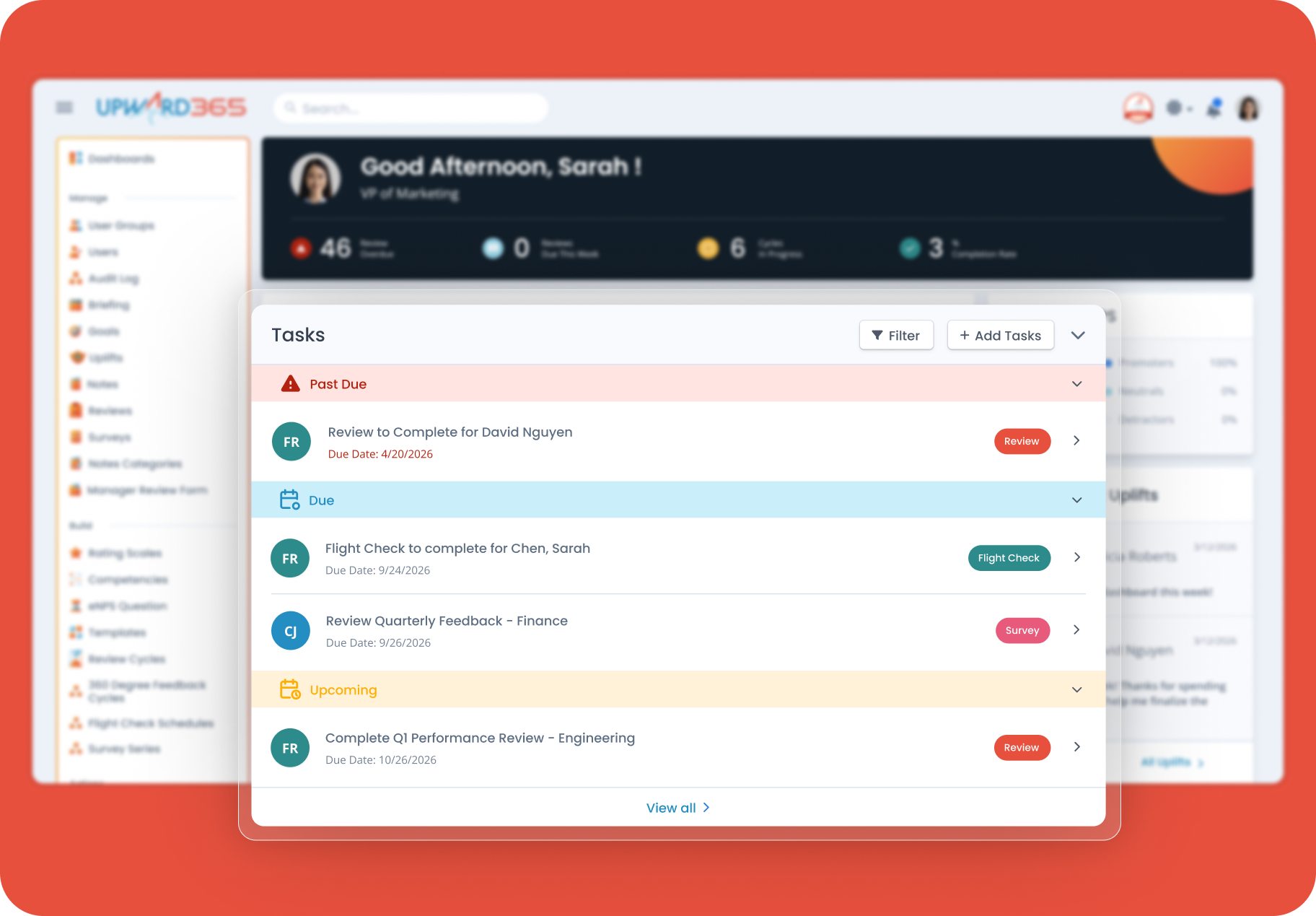
The Dashboard To Do Queue shows every manager what needs attention and links straight to it, so HR stops sending reminder emails in December.

The annual review arrives with the year already in it.
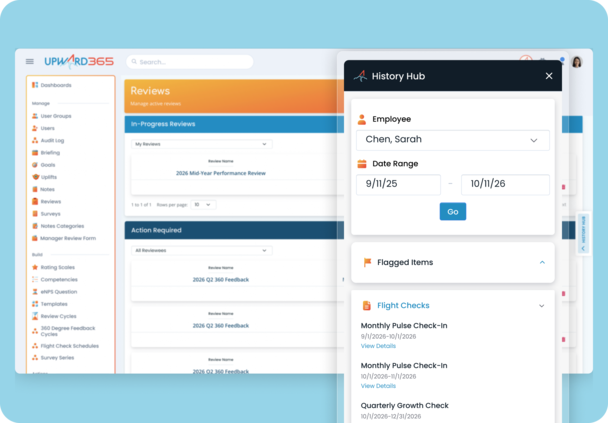
Notes, Uplifts and Flight Checks capture context as the year happens. History Hub surfaces it the moment the review opens, so the manager reads twelve months instead of reconstructing them.

Engagement sits next to performance.
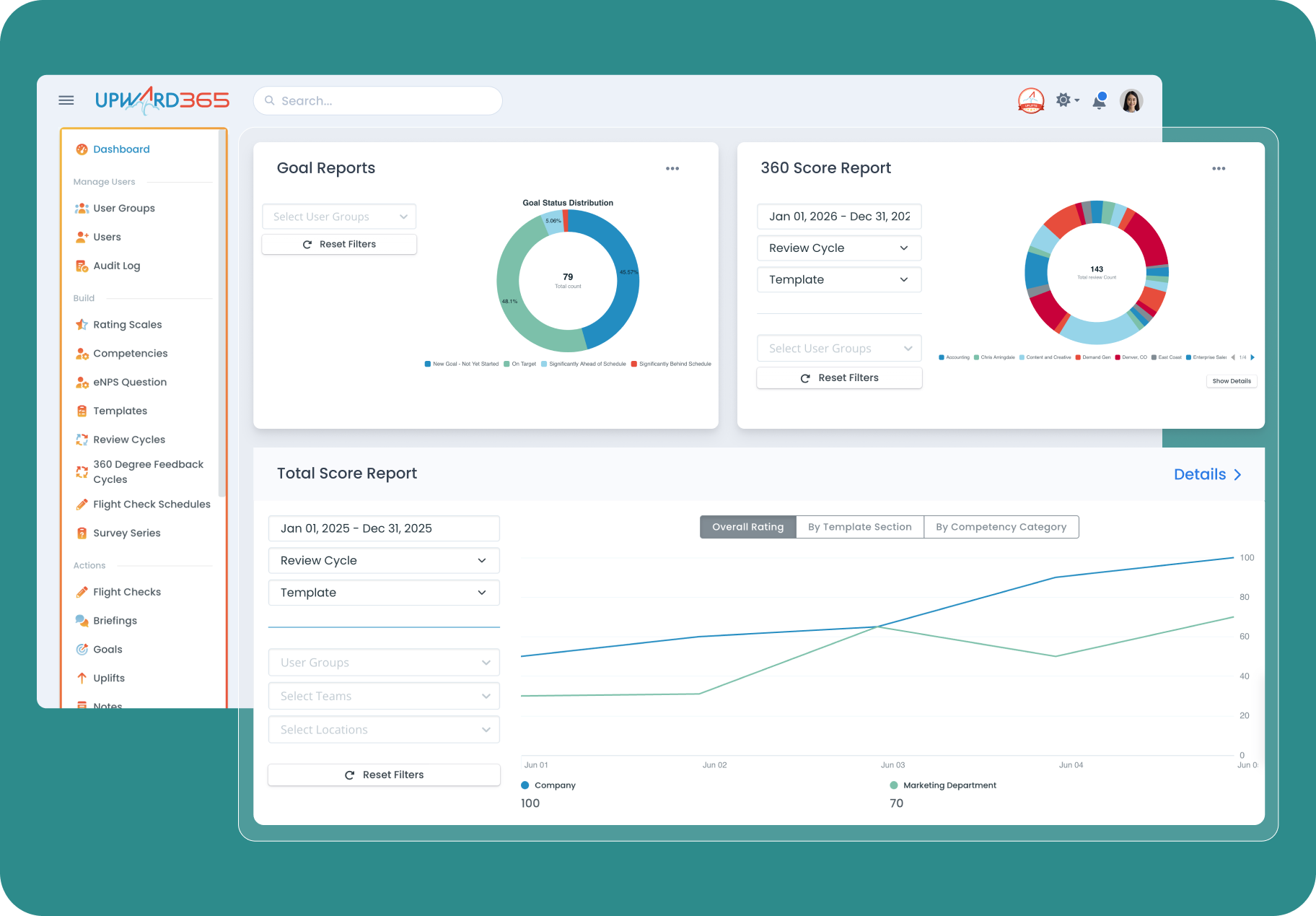
A dip in one is how you find out about the other in time to act. Reports pull both into a single layer for leadership.
No, and it is not built to. Upward365 does not handle payroll, benefits administration or recruiting. Its sole focus is helping employees perform better and stay engaged, and it works with the HR system you already run, so you get depth on the question your suite answers least well.
A real person who knows your account
A named person who only does this.
Every Upward365 account gets a named Account Manager who handles your demo, implementation, configuration and ongoing support, and that person knows the performance and engagement features specifically rather than covering payroll, benefits and a dozen other modules. Your Upward365 Account Manager knows how your review calendar is set up, you have their direct number, and questions and calls get an answer the same day, depending on when they come in. There is no handoff from sales to implementation to customer success, and the founders are reachable when you want them.

Performance management and employee engagement
HR records, payroll, benefits, hiring
Dedicated Account Manager for your entire lifecycle, direct number, same-day response, founders reachable
One support team spanning every module in the suite
Entire product
One module among many
Dynamic Template Builder, competencies by role
Varies, often fixed templates
Included as History Hub, Notes, Flight Checks
Rarely a distinct capability
Included
Varies, often a separate module
Included, works with major HRIS platforms
Not applicable, the suite is the HRIS
Dedicated Account Manager, configuration and online training included. Most accounts live within a month or sooner
Varies
Every Upward365 feature included at $8 per user per month
Commonly a higher plan tier
Locked for the full term. Changes at renewal only
Varies
Objections we hear
"We already pay for performance management inside our suite."
That module exists. The question worth asking is how deep it goes and how fast support responds when a review cycle breaks mid-cycle. Upward365's founders spent 20-plus years combined inside these systems and built this platform to fix the gaps they kept seeing in bundled modules.
"Managing another vendor is more work, not less."
One additional focused vendor with a named Account Manager is a different tradeoff than one broad vendor whose support queue spans every HR function. The point is not vendor count, it is whether the tool gets used. If nobody opens the module you already pay for, the vendor count argument is defending a line item.
"Switching means retraining every manager."
The Dynamic Template Builder loads the right competencies by role automatically, and the dashboard queue tells each manager what is due with a link to it. Your Upward365 Account Manager also runs the training sessions online, so it is not a rollout you staff yourself.
"Switching sounds like a project."
It is smaller than it sounds. The interface is straightforward enough that managers find their way around without a training manual, your Upward365 Account Manager handles configuration around your existing review calendar, and you can often import your team and start the same week.
Switching to Upward365
One call to see whether it fits.
No pressure ever, and if the answer is no, we will say so on the call rather than after it. But the transition from another platform to Upward365 is straightforward and relatively easy.
Your Upward365 Account Manager sets it up around your calendar.
They work with you to configure the platform around how your review cycle already works and run your training sessions online. You can often import your team and start the same week, and most accounts are fully live within a month, and often sooner, depending on your availability.
Sequence the rollout.
Some companies switch on the review workflow and year-round context first, then bring surveys and eNPS online once managers are in the habit. Others roll everything out from day one to take advantage of the link between performance and engagement. It's totally your call. Every Upward365 feature is included from day one, so nothing you turn on later costs more.
What each one costs
Every Upward365 feature. One transparent price.
Upward365 is $8 per user per month with a $4,000 annual minimum. Every Upward365 feature is included, along with HRIS integrations, with no performance tier to negotiate and no fee for setup, implementation or support. Your price is locked for your full contract term, and any change happens at renewal rather than mid-term. Features on the roadmap arrive at your price when they ship.
Suite pricing varies by vendor and most publish plan rates with the modules that matter quoted separately. The pattern worth checking on any suite you are evaluating is where performance management sits. It is frequently not in the entry plan, which means adding review cycles is a tier change applied to every employee, not a line item for the people who use it.
The comparison worth running is your suite's entry plan plus Upward365 against your suite's next tier up. Depending on the vendor those land close enough that price stops being the deciding factor, and the question becomes whether you want performance management that came with your HRIS or performance management that is somebody's entire product. Our named comparison pages show published pricing for specific vendors.
Upward365 is built for companies of 50 to 2,000 employees.

Upward365 is not an HRIS. If you are shopping for payroll, benefits administration or employee records, that is a separate purchase, and a broad HR suite is built for it. Upward365 works alongside whatever system you use today.
Upward365 can easily support larger organizations, but was designed for the small to mid-sized markets. If you're already outside that range, you may be better served by a platform focused on larger organizations.
If you are between 50 and 2,000 employees and want a platform your managers open and a person who knows your account and is there to help when you need it, that is exactly who Upward365 is built for.

Frequently Asked Questions
Common Questions When Comparing Platforms
Yes. Upward365 integrates with BambooHR and other major HRIS platforms, at no additional cost. If you prefer, users can also be provisioned by CSV import with a template, and your Upward365 Account Manager will walk through the setup during implementation.
Setup takes one more step than switching on a module, and your Upward365 Account Manager handles it: configuration around your review calendar, user import from your HRIS or by CSV, and training sessions run online. That is slower to start and faster to adopt. You can often import your team and start the same week, depending on your availability, and most accounts are fully live within a month or sooner.
Because the module in a broad suite is one of many priorities for that vendor's product and support teams, while performance and engagement is the entire product for Upward365. That shows up in feature depth, in review templates that adapt by role, and in support from a named person who knows the platform specifically.
User and organizational data imports by CSV at setup, using a template. Historical reviews and other records cannot be imported in bulk, but they can be added to an employee's Notes one at a time, which means they surface in History Hub when a manager writes that employee's next review. The old records end up where a manager will read them rather than in a folder nobody opens.
No. There are two ways to evaluate it instead. Book a Demo and your Upward365 Account Manager will walk you through the platform set up around how your team runs reviews. Or take the self-guided tour of a fully populated environment: name and email, at your own pace, no call required.
Companies between 50 and 2,000 employees, the range where a dedicated performance and engagement platform pays off without requiring an enterprise rollout.
Named comparisons are available for BambooHR, Lattice, 15Five, Leapsome, and PerformYard, each covering manager adoption, support, and published pricing.
The right tool is the one your people open.
And the one whose team picks up the phone. If the module you already pay for is not getting used, take a look.